In the realm of healing, patience is not just a virtue—it’s a necessity.
Many of us are conditioned to expect quick fixes. If something hurts, we want the pain gone now. If we’re sick, we want to be back to normal yesterday. Western medicine often caters to this mindset by focusing on immediate symptom relief. While this approach is sometimes essential—especially in emergencies—it doesn’t always address the deeper reasons why symptoms appear in the first place.
Traditional Chinese Medicine (TCM), by contrast, takes a broader and longer view. It’s not only about easing discomfort in the moment (what we call treating the branch) but also about understanding and correcting the underlying imbalances that created the issue (treating the root). This dual focus means the process of healing often requires time and consistency, but the results are deeper, stronger, and longer-lasting.
Healing Isn’t Always Quick—It’s Transformative

One analogy I often share is the difference between putting a car into reverse and putting a boat into reverse.
With a car, you can brake, shift gears, and move in the opposite direction very quickly. How quickly depends on your speed (the severity of your symptoms) and the road conditions (your environment—things like stress, diet, sleep, and lifestyle). The slower you’re going and the better the road conditions, the easier reversing occurs. In your body, if the issue isn’t too severe and your environment is supportive, you may be able to change direction and heal with relative ease.
With a boat, it’s different. Boats don’t have brakes, so you can’t stop on a dime. Instead, you need to put the boat into neutral or allow it to idle long before you need it to slow it down enough to reverse it. Healing deeply—especially when the underlying issue has been building for a long time—is much like this. You can’t expect an immediate reversal. Instead, it takes patience, steady effort, and the right conditions for the body to gradually slow its momentum, reset, and move in a healthier direction.
Some health issues are like the car: an acute ankle sprain, a seasonal cold, or a minor digestive upset. With the right support, your body can respond quickly, and you’re back on track in a relatively short time. Other conditions are like the boat: chronic joint pain, long-standing digestive disorders, hormonal imbalances, or autoimmune conditions. These require more time and consistent care because the body has been moving in that direction for months or even years. Just like putting a boat into reverse, it takes patience to slow the momentum, but once the shift happens, the healing can be profound and lasting.
A Personal Example: My Knees
Patience in healing is not just something I talk about with patients—it’s something I’ve lived myself.
I have a near lifetime of knee issues. When I was 12 years old, I was diagnosed with chondromalacia patella in both knees. That means I don’t have enough cartilage under my kneecaps, and the result is pain with certain activities. For that, I was given knee braces and shoe orthotics that only fit certain orthopedic-looking (in my pre-teen mind) shoes. I received physiotherapy and was given exercises. I learned that I would not be a runner, and doing anything downhill is a challenge.
But in my mid-20s when I started studying TCM, I discovered that my knees really could improve. I started getting occasional treatments for my knees and other issues, and low and behold, my knees bothered me less often. They stopped telling me when it was going to rain (yes, that’s a real thing). I was always active but had learned that I no longer had to suffer the day after most of my activities. I got rid of my knee braces—sold them to a friend’s boyfriend. I had to wear my orthotics less often—oh how sandals were/are my favourite! I still couldn’t run on pavement, but I dislike running anyway.
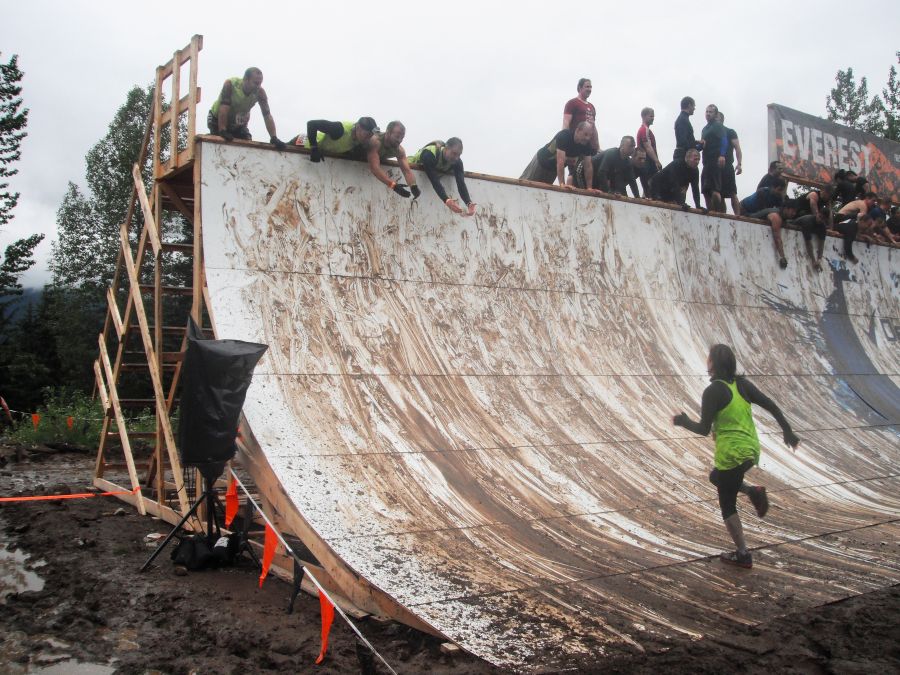
I did the Tough Mudder—which includes a near half marathon distance of running—when I as 40, and I had zero knee pain that day and the next. My knees, of course, were still nowhere near perfect. I liked the Grouse Grind because coming down The Chief was way tougher than going up for me. And I nearly tried tucking and rolling down Mount Kinabalu in Malaysia because the knee pain was so bad coming back down. But, overall, I didn’t feel that limited.
Then, sometime around 2018, I stood up from playing with my dogs on the floor, and I felt and heard something “POP!” in my left knee. I had torn my meniscus. Thankfully, I knew I could get treatment and do acupuncture on myself, which I did, and it recovered. Then again, a year later, I stepped out of my car and walked toward a gas station, and suddenly I was on the ground. My knee was out of commission again.
Yikes! At first, I was frustrated. I hadn’t done anything “worthy” of these injuries. I repeated what I had done the first time for treatment, but I was less patient this time. I was also a bit scared. Even as I healed and began to regain my range of motion, I was afraid to push it. I was worried that it would go again suddenly, for no apparent reason, because it had done that to me twice. “Fool me twice…” I thought.
After a while, I accepted that I may not be able to return to being able to comfortably settle into “child’s pose” or kneel with my seat on my heels again. I got used to using my right leg first when moving from the floor to my feet. I stopped doing the Grouse Grind because I was worried that I may need to be rescued if my knee went when I was partway up. I also pulled back from yoga for a number of reasons.
Last week, I started returning to in-person yoga classes. I was happy to discover that I could do child’s pose without problems, and kneeling was fine too, though I was careful. Then, partway through one of the classes, the teacher instructed us to go into Malasana, which is a deep squat. I was tentative. Could I do it? I moved slowly in, and…yay! No pain, no limitations, no fear. It felt fine. No, it felt great! I don’t assume that it will be easy every time. But that day took away most of my fear about my knee. I’ll still be careful to move mindfully, as yoga so wonderfully helps us do. But regaining the trust in my body feels like a huge blessing.
It didn’t happen quickly. Far from it. But doing acupuncture, taking herbs, practicing mindful movement activities, and giving it time worked. Not to say I can guarantee I won’t reinjure again. But for now, I can enjoy that today my knees are good.
Why Talk About Patience When It Comes to Healing?
Talking about patience in the healing process is so important because pain, injury, disease, or simply feeling unwell already brings enough suffering on its own. When frustration, fear, or worry are added on top, the burden becomes even heavier, and stress itself can interfere with the body’s ability to repair and recover. By cultivating patience, we can soften some of that emotional strain, reduce the mental pressure to “get better now,” and create a calmer, more supportive environment for true healing to take place.
Also, healing is not linear. Some weeks you may feel great progress, while other weeks feel like setbacks. This doesn’t mean you’re failing—it often means your body is recalibrating. Just like the boat still moves forward for a while before it turns, your symptoms may linger before the deeper shift happens.
Patience allows you to see healing as a process instead of a deadline. With this mindset, you can embrace the small victories, trust the treatments, and stay consistent even when change feels slow. And often, when that turning point comes, the results feel even more profound because you’ve built a foundation for long-term resilience.
Here are some things you might try to help build your patience and allow your body to heal:
- Commit to the basics: treatments, eating healthy, appropriate movement activities, rest, and restorative sleep.
- Celebrate small milestones instead of only focusing on the “finish line.”
- Trust that your body knows how to heal if given the right support.
- Practice mindfulness or breathing exercises to calm frustration and bring yourself back into the present moment.
- Remind yourself that healing isn’t linear—ups and downs are part of the process, not signs of failure.
- Ask for support when you need it—from practitioners, loved ones, or your community—so you don’t feel like you’re on this journey alone.
- Keep perspective by looking back—notice how far you’ve come, not just how far you have to go.
- Be kind to yourself—replace self-criticism with compassion, knowing that patience itself is part of the medicine.
What TCM Brings to the Healing Process
So how does TCM support this kind of healing, noting that it all types of healing, not just dealing with physical injuries and pain?
- Treating the branch: We address symptoms to give you relief, whether that’s reducing pain, easing digestive upset, calming anxiety, or improving sleep.
- Treating the root: At the same time, we look for what contributed to the problem in the first place. Is this something you’ve dealt with for years, decades? In what areas is your body strong and resilient and in what areas are you more vulnerable? By supporting the body’s root imbalances, TCM helps create conditions where true healing can take place.
This two-pronged approach is why patients often find that while their main complaint improves, they also notice better energy, stronger digestion, or deeper sleep. Healing is not just about removing what’s wrong; it’s about restoring what’s right.
An Invitation to Begin Your Journey
If you are dealing with pain, chronic health concerns, or simply feeling out of balance, I encourage you to consider this perspective: true healing takes time, but it is worth it. With the right support—whether through acupuncture, herbal medicine, lifestyle guidance, or a combination—you can experience not just temporary relief, but lasting transformation.
I work with patients every day who are learning to trust this process. Some come in for immediate concerns like injury recovery or stress relief. Others seek help for long-term challenges such as digestive issues, hormonal imbalances, or autoimmune conditions. Regardless of the starting point, the same truth applies: with patience, consistency, and support, the body is capable of remarkable change.
So next time you find yourself wishing for a quick fix, remember the car and the boat. Sometimes you can turn around quickly. Other times, it takes more time, steadiness, and patience. But in both cases, healing is possible—and often, the journey itself is what brings the deepest rewards.