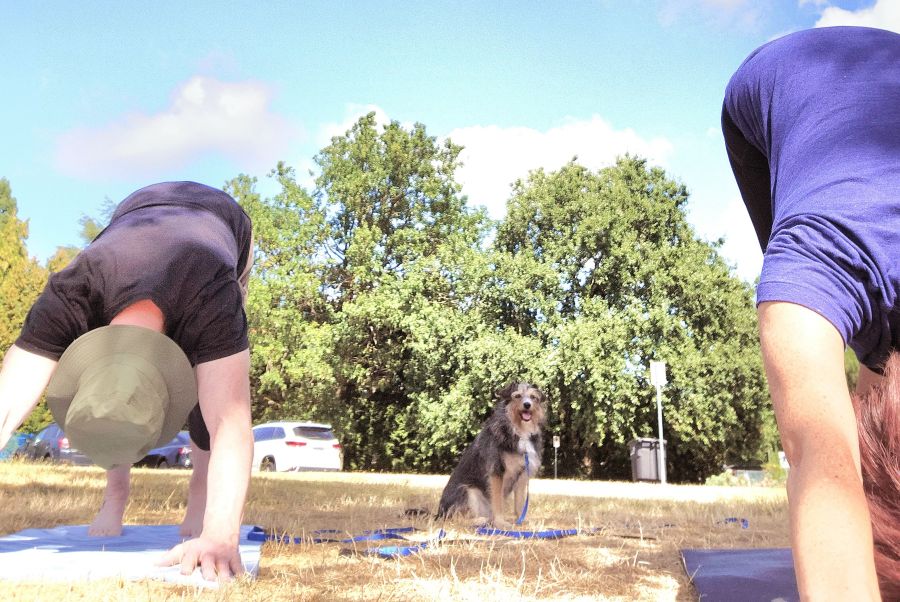
For about a decade, yoga was a regular part of my life. Then the pandemic happened. The studio I loved closed, and like many people, I tried to make online classes work. For me, that was a struggle. Something about practicing yoga alone in my living room, staring at a screen, just never felt the same.
As I looked for a new place to practice, I ran into another issue. It was hard to find spaces that acknowledged yoga as anything more than a physical workout. Classes focused almost entirely on strength, flexibility, or aesthetics. And while movement is certainly part of yoga, it’s only one small piece of a much larger system. Thankfully I’ve now found my yoga home again.
Yoga, traditionally, has eight limbs. The poses—asana—are just one of them.
I’m no yoga scholar or expert, but this stood out to me immediately, because I’ve seen this pattern before. I see it clearly in my own profession, in Traditional Chinese Medicine (TCM).
When the West Falls in Love with One Piece
Both yoga and TCM are ancient, holistic, and deeply integrated systems. They are rooted in cultural, philosophical, and medical frameworks that view the human being as more than just a body with parts to be fixed.
And yet, when these traditions arrive in Western contexts, something predictable often happens.
The West becomes enamoured with one aspect of the system. That one piece is then extracted, simplified, and repackaged, often in pursuit of faster results. In the process, much of the depth—and much of the power—is lost.
In yoga, that piece is the physical practice of asana, so much so that we equate “yoga” solely with the poses.
In TCM, that is most commonly acupuncture, but it is also cupping (“myofascial decompression (MFD)”), gua sha (“Graston technique” or “Instrument-Assisted Soft Tissue Mobilization (IASTM)”), and Chinese herbs.
Acupuncture Is Not Just Needling
Needling without a full TCM foundation is possible. It’s often called “dry needling” or “intramuscular stimulation (IMS),” but it’s also sometimes called “medical acupuncture.” These types of treatments stem from acupuncture, and I’ve seen them relieve certain types of pain. But they are not the same as acupuncture practiced within the context of Traditional Chinese Medicine.
TCM acupuncture is rooted in diagnosis, pattern differentiation, and an understanding of how the body’s systems relate to one another physically, emotionally, mentally, spiritually, and energetically. This type of acupuncture can calm the mind, regulate digestion, support sleep, shift mood, and create systemic change precisely because it is not just about inserting needles where it hurts or for a muscular response.
When acupuncture is stripped of its theoretical and diagnostic foundations, it may still “work” sometimes, but it no longer reflects the depth, intention, or scope of the tradition it came from.
The same thing happens with yoga.
Yoga Is Not Just Exercise
Yoga is an excellent form of physical movement. It builds strength, flexibility, and body awareness. But that isn’t its greatest strength. And it isn’t what yoga is ultimately about.
When I was early in my practice, I did a 40-day yoga challenge. When I was done, a friend who had been practicing yoga himself for years asked me, “How has yoga changed you?” Not “if.” How? And it had. I wasn’t yet clear exactly how, but I knew it had. Just as starting my path of studying TCM had changed me fundamentally…foundationally.
Yoga is a system for understanding suffering and alleviating it. It includes ethical principles, breath regulation, meditation, self-discipline, and insight. The physical practice exists to prepare the body and nervous system for deeper work, not to replace it.
When yoga is reduced to poses alone, something essential is missing. Just as needling without TCM diagnosis loses its context, yoga without its philosophical and mental components loses much of its meaning.
Shared Roots, Shared Wisdom
Traditional Chinese Medicine and yoga speak different languages, but they share the same worldview.
Both recognize a vital life force called Qi in TCM and Prana in yoga.
Both see the mind and body as inseparable.
Both prioritize balance over suppression and prevention over crisis care.
Both understand that healing takes time and requires participation, awareness, and consistency.
Why This Matters
In a healthcare and wellness culture that often prioritizes speed, convenience, and isolated interventions, it’s tempting to believe that we can take just one piece of a complex system and still get the full benefit.
We may get something.
But we don’t get everything.
The real strength of traditions like TCM and yoga lies in their wholeness, in the way each part supports the others, and in the way they invite us to engage with our health on more than one level.
As both a doctor of TCM and a long-time yoga student, I find myself wanting to educate and share about how we can get more when we honour this depth rather than flatten it. Because whether it’s yoga or acupuncture, poses or needles, these practices were never meant to stand alone. They were meant to connect us to ourselves, to our bodies, and to the larger systems we’re a part of.
And when we allow them to remain whole, they offer far more than quick fixes.
They offer wisdom.